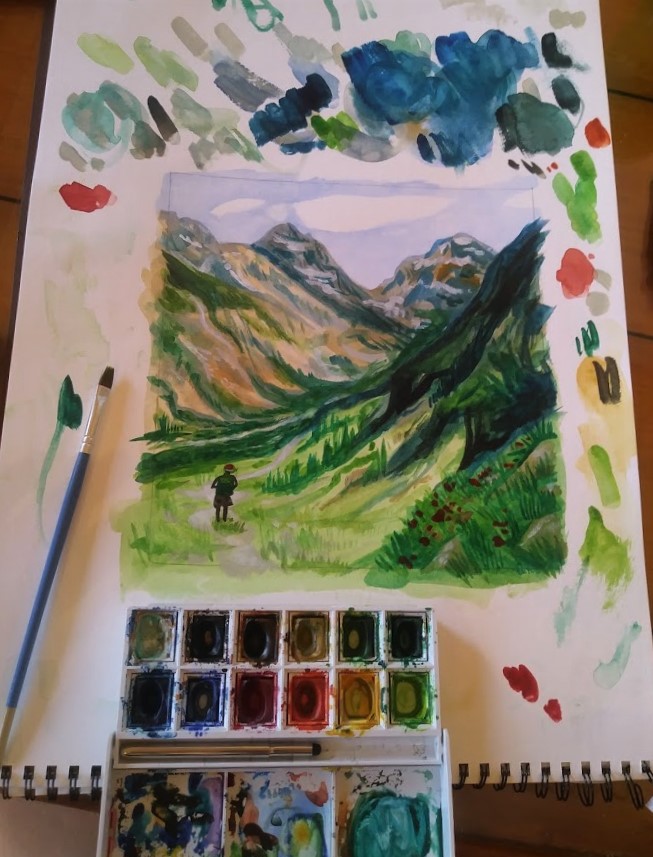
As a double major in both English Education and Visual Art, I hope to be certified to teach both. English and art have both become major parts of my identity, but in school all I knew was that I liked to read and draw. English is a firmly established subject in secondary education, but art is often overlooked or under-emphasized. I know that most people are not artistically inclined. However, there is so much value in pursuing creativity in ways not commonly seen in the average classroom.
The arts bring value and creativity to all students, not just those who identify as artists. Pursuing creative expression in the classroom results in “Increased self-confidence and self-understanding, enhanced communication skills, and improved cognition” (Swapp, 2016). There is scientific research to support why students should have exposure to art classes, but they are still not prioritized in most schools. In my experience, art classes were few and far between. As a future teacher, I want to start looking for ways to incorporate different types of creativity in the English classroom, creating opportunities for students to think in new ways.
I want to help foster creativity in my future classroom, and I think that one way to do this is to offer choices for students on big projects. I decided to make a list of possible assignments and options for students, so that in the future I can use this list as a resource for lesson planning.
Creative Options for Projects:
- Write a journal from a chosen character’s point of view
- Create a (diorama, painting, sculpture, presentation, or journal entry) for your chosen book
- Get in a small group and act out a scene from a play
- Paint a scene from the book and write a brief description of it
- Pick your favorite character from the book, draw/paint/create a portrait of how you imagine them, write a brief description of their characteristics
- Create a stop-motion animation of a scene from the book
- Cook a dish from the country that the book takes place in, bring it in for the class (could be extra-credit)
- Illustrate a timeline of the events in the book
One of my favorite assignments was in high school, when were each picked a book to read over the summer and had to do a book report. My teacher offered many options for creative book reports, including skits, dioramas, paintings, and presentations. When teachers give their students these options, they are not only providing an outlet for creativity, but they are giving kids a chance to express themselves and be individuals. When you have more options than just a simple power point presentation, you have the ability to put some of yourself into it, even if you did not enjoy the material. In this way, creative outlets can motivate students to put in work even when they don’t like the material.
When my teachers gave me options, I felt seen and heard in a way that regular assignments never accomplished. I want to bring my love of art and creativity to my future classroom in the same way that my favorite teachers did, providing artistic and personal expression, allowing for individuality, and encouraging students to make assignments motivating for them.
More Resources for the future:
- https://www.weareteachers.com/creative-book-report-ideas/
- https://teachnet.com/lessonplans/language-arts/more-ideas-than-ever-book-reports/
- https://writeshop.com/10-ideas-for-creative-book-reports/
Works Cited:
Swapp, Neil. “Creativity and Academics: The Power of an Arts Education.” Edutopia, George Lucas Educational Foundation, 4 Oct. 2016, https://www.edutopia.org/blog/creativity-academics-power-of-arts-education-neil-swapp.

 Audrey's Blog
Audrey, what an interesting combination; a major in English and Visual Arts sounds fascinating! You are 100% right that giving students options will lead to more engaged and invested students. My students in 6th grade do a research project at the end of the year and I give them a list of lots of options on how to show their knowledge. The tricky part is how to ensure that all projects meet the standard required by the Colorado Department of Education. For instance, just for Standard 4: Research and Reasoning, students must show evidence of meeting all the skills listed below. I have found that conferring with individual students is essential during the planning process, but this, as you can imagine, takes a lot of time. Also, pre-teaching the skills prior to allowing them to run-free with a project is also incredibly helpful (dare I say, necessary?).
6th Grade Research and Reasoning Standard #4 (The below standards are 1 out of 3 measurement topics under the Research and Reasoning Standard)
a. Conduct short research projects to answer a question, drawing on several sources and refocusing the inquiry when appropriate. (CCSS: W.6.7)
i. Identify a topic for research, developing the central idea or focus and potential research question(s)
b. Gather relevant information from multiple print and digital sources; assess the credibility of each source; and quote or paraphrase the data and conclusions of others while avoiding plagiarism and providing basic bibliographic information for sources. (CCSS: W.6.8)
i. Use a range of print and nonprint sources (atlases, data bases, reference materials, online and electronic resources, interviews, direct observation) to locate information to answer research questions
ii. Locate specific information within resources using indexes, tables of contents, electronic search key words, etc.
c. Draw evidence from literary or informational texts to support analysis, reflection, and research. (CCSS: W.6.9)
Follow established criteria for evaluating accuracy, validity, and usefulness of information
Select and organize information, evidence, details, or quotations that support the central idea or focus
iii. Apply grade 6 Reading standards to literature (e.g., “Compare and contrast texts in different forms or genres [e.g., stories and poems; historical novels and fantasy stories] in terms of their approaches to similar themes and topics”). (CCSS: W.6.8a)
Apply grade 6 Reading standards to literary nonfiction (e.g., “Trace and evaluate the argument and specific claims in a text, distinguishing claims that are supported by reasons and evidence from claims that are not”). (CCSS: W.6.8b)
LikeLiked by 1 person