“Until I feared I would lose it, I never loved to read. One does not love breathing.” – Harper Lee
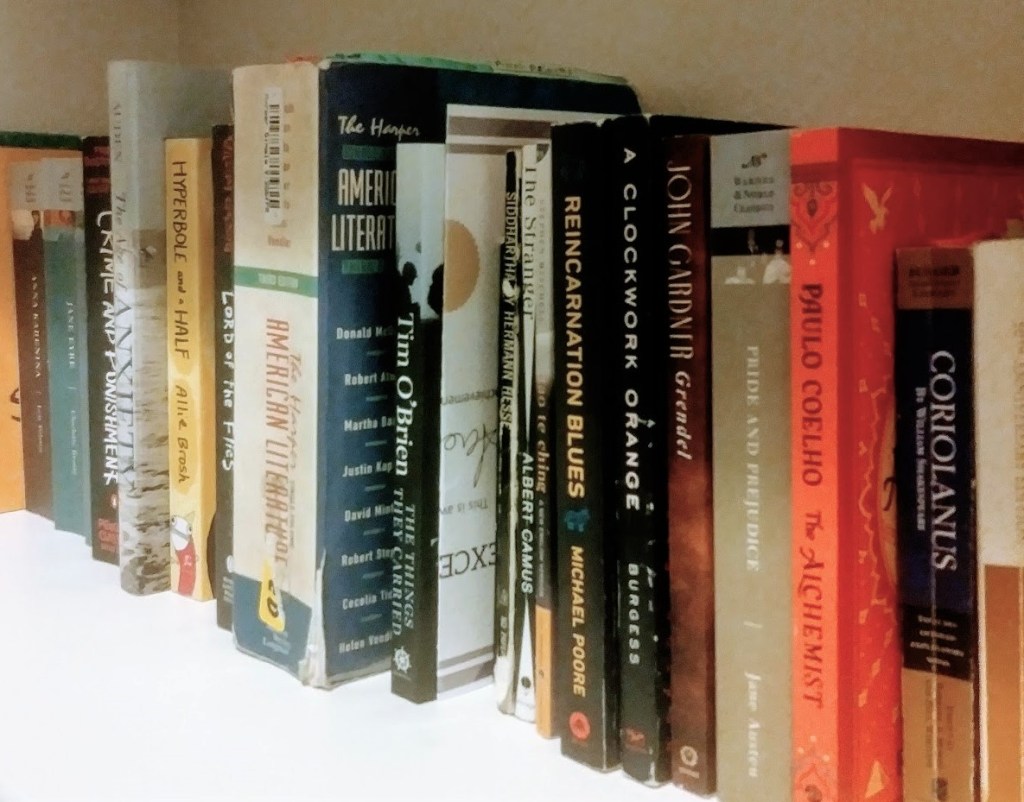
When I entered 6th grade, books stopped being fun. Somehow I had internalized an unspoken rule of middle school, that I could no longer read about magic and mermaids anymore. This was not explicitly stated, yet somehow I still believed that the treasured books of my childhood were now off-limits for me, a Very Grown Up 6th grader. So instead of reading about fantastical quests, loyal friends, and mysterious beasts, I followed my older brother’s lead and dove into the genre of existential philosophy.
Yes, this was a very questionable decision for a twelve-year-old, but my reading habits had never been monitored before, so it was no big deal when I read The Myth of Sisyphus, by Albert Camus, Beyond Good and Evil, by Friedrich Nietzsche, and the novel A Clockwork Orange, by Anthony Burgess.
What resulted from this rapid consumption of philosophy was the death of enjoyable reading for me. Although it was self-imposed, my world had mutated from fairies and gentle morality into dark spiraling investigations about the meaning of life. For the next few years, this was my entire reading experience, other than the few books that were required for my English classes.
After my brother graduated from high school and there was no one to supply me with reading, I stopped it altogether. For the next few years, I read only what was necessary for getting satisfactory grades, and forgot completely about my childhood book joy. When I got to college however, I took an introductory Literature class and instantly fell in love with the material. As an English major now, I am very aware of how important reading is to me. I read for class, I read outside of class, I read when I walk, when I travel, and I connect with people around me through books. Reading is and has always been very important to me, which is why those years without books was one of the saddest times of my life.
Reading allowed me to believe in magic, and the good in people, so when I cut myself off from this safe haven, I lost a lot more than just a source of entertainment.
Everyone has endured the trials of middle school, so we are all aware of how difficult it can be. While weathering changes in physical and mental states, unpredictable social structures, and peer pressure to conform, middle-schoolers also endure the loss of their childhood books (whether this is self-imposed or peer imposed). When kids stop having books that they enjoy reading, there is no motivation to read at all, and as teachers or future teachers, we are all very aware of how negatively this affects them.
Since starting college I have learned how important reading is, and how much it changed the course of my life when I stopped reading. Through my journey to becoming an educator, I hope to gather the tools that I will need to encourage children to read and explore the voices of other people, and be able to teach them love, empathy, and how to enjoy life, using the books that would have helped me when I was their age.
Right now, I don’t know what these tools will look like or how this journey will go. I can only hope that I will learn how to help motivate myself and the future teachers around me to prioritize reading for our students, because we all know how it can change lives.
I have not done very much research into current middle school reading programs, but here are some resources for my future self and anyone who is interested:
Cultural and linguistic diversity is highly important in my current education classes at Colorado State University. I know that I am extremely lucky to be learning how to be a teacher in this time of social progress and acceptance, but I am also painfully aware that many schools in the U.S. do not have this luxury. The documentary Precious Knowledge: Fighting for Mexican American Studies in Arizona Schools depicts the terrifying reality of modern institutionalized racism and how it affects students.
The documentary follows the students of Tuscon High School, as they develop from resistant and quiet freshman to active, passionate voices in their community. Their growth as students is largely attributed to the school’s Ethnic Studies Program. While “48 percent of Mexican American students currently drop out of high school, Tucson High’s Mexican American Studies Program has become a national model of educational success, with 93 percent of enrolled students, on average, graduating from high school and 85 percent going on to attend college” (Palos, McGinnis). Not only did this program dramatically lower drop-out rates for the high school, but it allowed students to feel validated in their identities and build academic confidence.
Through interviews with the students and teachers in the program, the documentary showed the value of the Ethnic Studies Program better than any statistics. Students learned how to express themselves, the history of their ethnic identities, and how to have pride and confidence for who they are. They started to care about what they were learning, because “there [was] meaning in the work” (Palos, McGinnis) that was tangible and important to them. For the first time, these students were given a positive learning experience that centered around their culture. This led to significant improvement in standardized test scores and a remarkable graduation rate of 93% (Palos, McGinnis).
However, after the hard work of teachers and students, the increased graduation rates and test scores, and the life changing results of the Ethnic Studies classes, the local government of Tuscon demanded a ban on the classes, Attorney General Tom Horne claimed that they were “un-American” (Palos, McGinnis). The students and teachers fought against this proposed ban, desperately clinging to the source of cultural pride and education that had allowed them to succeed in school. After protests, counter-protests, student testimony about the value of the classes, walkouts, an anti-discrimination lawsuit, and multiple arrests, the bill to ban the classes was passed and became a law. The classes were cancelled, the students graduated, and the teachers were reassigned (Palos, McGinnis).
The community around Tuscon High School learned cultural pride and academic integrity. These students started succeeding in school through learning about something they really cared about, their heritage and identity. Tom Horne’s idea that a celebration of culture is “un-American” is absurd. The United States “steadily evolved to define Americans by their shared values, not by their superficial appearance” (Hanson), and it was the diversity brought by immigrants that defined and enriched American culture. Tom Horne’s definition of “American” excluded the cultural identity that allowed these students to succeed in school. The loss of the Ethnic Studies Program was tragic not only for the students who were directly affected, but for the whole of American society that benefits from the diversity of the “melting pot”.
Racism has been prevalent in the education system, seen throughout history in the oppression of all non-white students. In the past, Spanish was not allowed in schools, and corporal punishment was used for Mexican-American students four times more than for white students (Palos, McGinnis). Examples of this racism can be seen in all American institutions. European Americans make up 70% of the population and 30% are in prison, while only 12% of the population is African American and 41% are in prison. This shocking disparity is indicative of a large-scale failure in American institutions, and the racism that persists today. Considering these statistics, it is not at all surprising that these same failures have spread to our education system.
As a college student, I am surrounded by progressive idealism. It is easy to hear professors speak about diversity and imagine all the phenomenal progress that we have made. However, this is not reality faced by most Americans. The story told by Precious Knowledge reminds me just how much work we have ahead of us, and how important it is that I learn how to help my future students fight for their rights.
I have mentioned my Professional Development text before, but Rozema’s book Seeing the Spectrum: Teaching English Language Arts to Adolescents With Autism is such a valuable resource that I felt it necessary to dedicate an entire post to evaluating these classroom strategies. Not only does the book describe the cognitive and behavioral aspects of Autism Spectrum Disorder (ASD), but it has considerable resources for English teachers to use in the classroom. Even better, it approaches everything from an asset-based perspective, considering the ways that individuals with ASD are unique and skilled, rather than any struggles they may face in the classroom.
For a little introductory information, Autism Spectrum Disorder is “brain-based disorder characterized by social-communication challenges and restricted repetitive behaviors, activities, and interests” (Autism Science Foundation), and is described in two distinct categories: deficits in social communication and interaction, and “restricted, repetitive patterns of behavior, interests, or activities” Rozema, 3). Seeing the Spectrum describes Autism as less of a ‘spectrum’ and actually a “cluster of associated conditions related to the two core diagnostic criteria–again, social communication challenges and restricted, repetitive behaviors” (Rozema, 4).
Emotional Dysregulation and anxiety: Many individuals with Autism experience a “loss of emotional control”, or “an impoverished ability to cope with and control intense, especially negative, emotions” (Rozema, 15), which is defined as emotional dysregulation. In the English classroom especially, this results in students’ inability to work with commonly used texts, as most works of literature feature emotional themes and negative events. However, Rozema presents strategies for teachers to use with these students, in order to help them access the material and benefit from their lessons. These strategies include:
The use of “safe texts”, either using texts that are not upsetting to students, or allowing for non-fictional or graphic novel substitutes
Working with students to develop positive coping strategies, for example working “with the student to establish a routine for releasing negative emotions and maintaining control. This routine should allow the student to move, discreetly, to a predetermined place in the room where [they] can practice stress-reducing activities” (Rozema, 20)
Perspective Taking: According to Rozema, many individuals with ASD struggle with cognitive empathy, defined as “how well an individual can perceive and understand the emotions of another… having more complete and accurate knowledge about the contents of another person’s mind, including how the person feels” (Lesley University). Within literature and most types of reading, the reader is required to do a certain amount of empathizing with the speaker and the characters. Individuals with Autism struggle with this “perspective-taking”, which results in difficulties understanding English classwork and reading assignments. Rozema suggests strategies to help students think about perspective, attempting to “pair visual and verbal elements, applying the thinking map method to the issue of perspective-taking” (Rozema, 28). These strategies include:
Mind signs: In this assignment, the students use an index card for each character to create a ‘mind sign’, consisting of three statements about the beliefs of the character, using drawings or colors to differentiate between assumptions and emotions
Symbolic storyboard: A method for keeping track of character’s shifting beliefs, the students use the storyboard to pair drawings and visuals with a storyboard that tracks each character’s beliefs
Mind map: Students choose a character, then label their brain using categories of things that they are concerned with/any false beliefs they may hold
Writing and Executive Function: Writing can be especially hard for individuals with ASD, this is due to the fact that “the control panel of the autistic brain does not operate efficiently in carrying out executive functions, or tasks that require emotional, physical, and cognitive regulation and self-control” (Rozema, 61). This includes difficulties with planning, working memory, and central coherence, all cognitive abilities that are used in the writing process. Rozema’s strategies for helping students with ASD work through these difficulties in their writing include:
Using high-interest topics, in order to motivate students to do the work that writing requires, it helps immensely if they care about their topics
Explicit goals and small steps, breaking “the writing process into discrete, achievable steps with explicitly stated objectives for each stage” (Rozema, 71) allows students to understand what their assignments ask for, and waste less time trying to figure out what is required
Using visual supports, including digital tools like tablets to show students the assignments in different ways, graphic organizers, to-do lists and check boxes for sequential work, and creative use of technology
Though these are only a few of my many takeaways from Seeing the Spectrum, I hope to utilize these strategies in my own classroom someday. Rozema’s text is highly practical, and should be a staple for any educator who wants to learn quick strategies for helping their students with ASD in the English classroom and beyond.
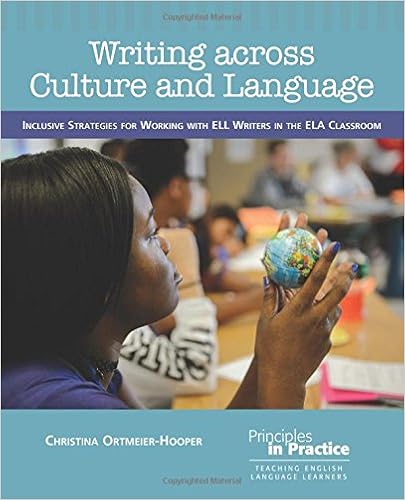
This week I was reading about the strengths of English Language Learner (ELL) and multilingual students in the classroom from Writing across Culture and Language by Christina Ortmeier-Hooper. The book uses an asset-based approach to teaching classes with multilingual and ELL students. Asset-based teaching “seeks to create lifelong learners who are confident in their abilities to master new skills” through focusing on student’s talents rather than their deficits (ACRL Instruction). This method of treating students with optimism, focusing on their abilities and how they contribute, is the hopeful alternative to teaching students from a deficit-based perspective, where they learn about what they can not do and internalize the message that there is something wrong with them. In today’s political and social climate, it is increasingly important to model an asset-based approach, specifically for students of different cultures and ethnicities, to teach a message of acceptance and inclusivity.
In Writing across Culture and Language, Ortmeier-Hooper describes the concept of ‘translanguaging’, defined in the book as “the flexible use of language resources in order to make meaning in our lives and in our complex social and academic worlds” ( Ortmeier-Hooper, 28). She elaborates, describing how translanguaging allows multilingual students to think and interact with many different language codes simultaneously, developing the ability to “pull from a single, rich linguistic repertoire that brings together all their language resources, and they have learned to deploy those resources in selective, strategic, and effective ways”(Ortmeier-Hooper, 29). This asset-based perspective uses research and factual evidence, allowing educators to see their multilingual and ELL students as extremely advanced in their linguistic and code-switching abilities. When we think of our students as gifted and complex thinkers, our expectations are higher, which allows us to help them succeed.
ELL students are developing in complex ways and have advanced linguistic and code-switching abilities, but they are also learning a new language. How do we, as educators, make the classroom as functional and helpful for them as possible? From Writing across Culture and Language, personal experience, insights from International college students, and additional resources, here are a few strategies for teachers to welcome multilingual students in the physical space of the classroom as well as the social environment:
Incorporating music from different cultures and languages allows students to access different codes and levels of understanding
Learning the proper pronunciation of unfamiliar student names in private to avoid repeatedly asking
Labeling classroom items in multiple languages
Ice-breaking activities for students to get to know each other in a low-risk environment
Using table-work or small group activities to allow students to build confidence speaking, give more time for reflection, and allow them to practice before larger discussions
Pre-teaching, consider background knowledge or vocabulary words that students will need to know before a lesson or text, a lot of this information is culturally-specific (handouts with author names/concepts/vocabulary words in advance)
Make sure students are comfortable in new culture/with specific customs
For writing: ideas about “good writing” differs between cultures, make sure to be aware of this when grading work and make your expectations clear and consistent
Allow for speaking opportunities in class, such as mini-presentations (let students choose their own topics), group work, or discussions, give them opportunities to work one-on-one with teacher first to build confidence
Ortmeier-Hooper, Christina. Writing across Culture and Language: Inclusive Strategies for Working with ELL Writers in the ELA Classroom. National Council of Teachers of English, 2017.
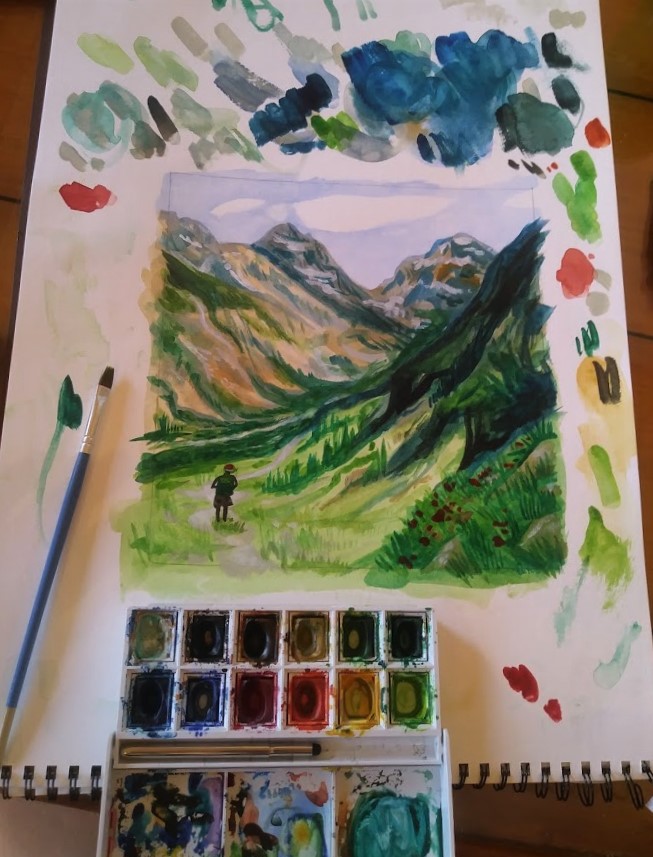
As a double major in both English Education and Visual Art, I hope to be certified to teach both. English and art have both become major parts of my identity, but in school all I knew was that I liked to read and draw. English is a firmly established subject in secondary education, but art is often overlooked or under-emphasized. I know that most people are not artistically inclined. However, there is so much value in pursuing creativity in ways not commonly seen in the average classroom.
The arts bring value and creativity to all students, not just those who identify as artists. Pursuing creative expression in the classroom results in “Increased self-confidence and self-understanding, enhanced communication skills, and improved cognition” (Swapp, 2016). There is scientific research to support why students should have exposure to art classes, but they are still not prioritized in most schools. In my experience, art classes were few and far between. As a future teacher, I want to start looking for ways to incorporate different types of creativity in the English classroom, creating opportunities for students to think in new ways.
I want to help foster creativity in my future classroom, and I think that one way to do this is to offer choices for students on big projects. I decided to make a list of possible assignments and options for students, so that in the future I can use this list as a resource for lesson planning.
Creative Options for Projects:
Write a journal from a chosen character’s point of view
Create a (diorama, painting, sculpture, presentation, or journal entry) for your chosen book
Get in a small group and act out a scene from a play
Paint a scene from the book and write a brief description of it
Pick your favorite character from the book, draw/paint/create a portrait of how you imagine them, write a brief description of their characteristics
Create a stop-motion animation of a scene from the book
Cook a dish from the country that the book takes place in, bring it in for the class (could be extra-credit)
Illustrate a timeline of the events in the book
One of my favorite assignments was in high school, when were each picked a book to read over the summer and had to do a book report. My teacher offered many options for creative book reports, including skits, dioramas, paintings, and presentations. When teachers give their students these options, they are not only providing an outlet for creativity, but they are giving kids a chance to express themselves and be individuals. When you have more options than just a simple power point presentation, you have the ability to put some of yourself into it, even if you did not enjoy the material. In this way, creative outlets can motivate students to put in work even when they don’t like the material.
When my teachers gave me options, I felt seen and heard in a way that regular assignments never accomplished. I want to bring my love of art and creativity to my future classroom in the same way that my favorite teachers did, providing artistic and personal expression, allowing for individuality, and encouraging students to make assignments motivating for them.
Colorado State University hosts an annual Diversity Symposium, featuring more than 50 free sessions that are open to anyone. This year I went to “Including Students with Intellectual and Developmental Disabilities in Higher Education”, presented by Shelby Bates, the Outreach Coordinator for the Colorado Initiative for Inclusive Higher Education, and James Graham, the Director of the Center for Community Partnerships and Professor in the Department of Occupational Therapy at CSU.
This session discussed The Colorado Initiative for Inclusive Higher Education, whose websites states their mission as “Creating fully inclusive college opportunities in Colorado for students with intellectual disabilities to foster academic growth, social development, and career advancement” (IN Colorado Initiative for Inclusive Higher Education). The ultimate goal of this program is long-term success and independence for students with intellectual disabilities, giving them opportunities for higher education that have not been available in the past.
“Students with intellectual disabilities who successfully complete an inclusive, post-secondary education realize a competitive employment rate over 70%, compared to less than 30% for similar adults with no post-secondary education” ( IN Colorado Initiative for Inclusive Higher Education), and according to Bates and Graham, 65% of students in the program had a paid job in their community one year after exiting. These are exciting statistics, new opportunities that present circumstances which allow people with intellectual disabilities to continue their education after high school. The term “inclusive education” is defined as involving “a transformation of the education system with changes and modifications in content, teaching methods, approaches, structures, strategies, and review mechanisms in place”, which is usually contrasted with “segregated education”, defined as when “students with disabilities are educated in separate environments (classes or schools) designed for students with impairments or with a particular impairment” (Inclusion International).
What most shocked me about the session was my own lack of knowledge. I have never learned information about higher education for students with intellectual disabilities, and I never considered its importance. In addition to the difference between segregated and inclusive education, I learned the difference between accommodations and modifications. “An accommodation changes how a student learns the material. A modification changes what a student is taught or expected to learn” (The Understood Team).
Ultimately, the Colorado Initiative for Inclusive Higher Education aims to foster independence, academics, career preparation, and social confidence. This program is not mandated, but should still be adopted by universities dedicated to diversity and inclusion.
Recently I began reading Seeing the Spectrum: Teaching English Language Arts to Adolescents with Autism, by Robert Rozema, and was shocked by my lack of knowledge about Autism Spectrum Disorder, or ASD. According to Rozema, the autism ‘spectrum’ is actually “a cluster of associated conditions related to the two core diagnostic criteria”, which are “social communication challenges and restricted, repetitive behaviors” (4). In the beginning of the book, Rozema describes one student with autism’s reaction to reading literature with “sad and scary” (14) themes, including violence and the deaths of animals. One challenge that some people with autism face is emotional disregulation, or “an impoverished ability to cope with and control intense, especially negative, emotions” (15), including the student in Rozema’s study.
This presents an issue for English teachers specifically, as most if not all works of literature explore “sad and scary” things. So what is the solution? We need our students to learn, but we must also make accommodations for students who learn in different ways. Rozema presents possible solutions, such as working to “minimize anxiety and prevent negative behaviors by selecting materials carefully and by teaching coping strategies to help autistic students… manage their emotions” (18). These alternative texts can be informational, or graphic novels, which are “a frequently cited interest of autistic individuals” (19).
So I decided to make a list of possible alternatives for texts that are commonly taught in 6th-8th grade, to scaffold the reading options of students with ASD and give them options for reading. I compiled a list of books that can replace these frequently taught texts, including Nonfiction and graphic novels that may be easier to read for some students.
Middle school reading and possible alternatives:
The Boy in the Striped Pajamas, by John Boyne -This novel explores the life of a 9 year-old boy during the Holocaust. -Nonfiction alternatives: A History of the Holocaust by Rita Steinhardt Botwinick, or World War 2, by Aaron
The Absolutely True Diary of a Part Time Indian by Sherman Alexie -Alexie tells the story of a Native American teenage on the Spokane Indian Reservation. -Nonfiction alternative: Ojibwa Warrior: Dennis Banks and the Rise of the American Indian Movement by Dennis Banks
To Kill a Mockingbird, by Harper Lee -This book deals with racial inequality and prejudice in the South during the Great Depression. -Nonfiction alternative: What was the Great Depression by Janet B. Pascal
Night by Elie Wiesel -This book describes the author’s experiences in Nazi concentration camps during the Holocaust. -Graphic novel alternative: Maus by Art Spiegelman
Of Mice and Men by John Steinbeck -This novel describes the lives of two migrant workers during the Great Depression. -Nonfiction alternative: Industrialization Through the Great Depression by Cindy Barden and Maria Backus
Other educational graphic novels:
They Called Us Enemy, by George Takei, Justin Eisinger, and Steven Scott -This book is about Japanese internment camps during World War II.
Persepolis, by Marjane Satrapi -This book is an autobiography about the author’s life growing up in Iran during the Islamic Revolution.
The Time Museum, by Matthew Loux -This book is about a group of kids and their adventures through different time periods.
Ancient Egypt: Tales of Gods and Pharaohs, by Marcia Williams -This book is a historically accurate retelling of different ancient Egyptian myths.
The Odyssey, by Gareth Hinds. -This is the graphic novel version of Homer’s epic poem
Works Cited:
Rozema, Robert. Seeing the Spectrum: Teaching English Language Arts to Adolescents with Autism. Teachers College Press, 2018.
Teachers change lives. Not only do they provide the power of education and the ability to access it, but they play a crucial role in their students’ social development as well. For good or bad, teachers are the people that model empathy, kindness, and compassion for children. They not only contribute to students’ own self-worth and confidence, but they model how to treat other people as well.
Last year I decided to major in English Education and become a teacher. After exploring other subjects, taking a variety of classes, and volunteering with kids, I knew that I wanted to make an impact this way, to try to help children in their highly formative middle school years. This same year, a time of idealism and excitement for me, I read an article that left me terrified for the responsibilities of a career in teaching.
I was unable to find the exact article that I read last year, but it has been covered in recent journals. It described a highly controversial and ongoing court case against a group of L.A. Country social workers. In this case, the social workers in question were responsible for an 8-year-old boy named Gabriel who had been added to their watch lists for abuse and neglect. Through many horrifying failures in the larger system, Gabriel was brutally tortured by his mother and her boyfriend, never removed from the home, and in May of 2013, “paramedics arrived at the boy’s Palmdale home to find Gabriel not breathing. His skull was cracked, three ribs were broken and his skin was bruised and burned. He had BB pellets embedded in his lung and groin. Two teeth had been knocked out” (Etehad, Winton, 2017).
When describing the events that lead up to the child’s horrifying murder, the original article interviewed Gabriel’s teacher, Jennifer Garcia. She described seeing signs of the abuse, such as “a facial bruise the size of a half-dollar”, “facial bruises, scabs, missing tufts of hair, busted lips”, and “swollen eyes and a pockmarked face” (Etehad, Winton, 2017). Garcia was persistent in asking her student what had happened to him, and eventually he told her about how his mother and her boyfriend tortured him. Garcia followed the proper steps to take when reporting child abuse, including reporting the incidents to her principal and calling Gabriel’s social worker. However, “she began to lose confidence in child protective services as months passed and Gabriel remained with his mother” (Etehad, Winton, 2017). Gabriel continued to come to class with severe physical wounds, and even told her that his mother beat him worse after the social worker called. Garcia was trapped between the rules of a broken system and the suffering child who was injured worse when she tried to help. Gabriel’s social workers maintained that he was not in immediate danger and that they had more urgent cases that required their resources.
Obviously this was wrong. After a lifetime of abuse and suffering, Gabriel was murdered. Following his death, the social workers on his case were prosecuted for failing to protect him. And his teacher was left with the knowledge that she could not save him, despite following the rules she was given for this very situation. I can only imagine the grief she is left with, as well as the knowledge that she can not fully protect her students in a system that continues to fail. After the sentencing of the murderers, she said “she believes the entire system failed her student” (Gerber, 2018).
Teaching after the murder of one of your students, especially one you were so personally involved in trying to help, seems impossible to me. I know why I want to teach, and I am passionate about helping my future students. But I also know that I would be unable to see the rest of my class with the awareness that they were at the mercy of a larger system that was capable of failing so catastrophically.
This leads to the point of this blog post. How much power should teachers have? Obviously they are involved in students lives to help them learn, but where should their role end? Jennifer Garcia had no power to protect Gabriel, even when she was the only person in his life actually seeing what was happening to him. His social workers made decisions based on casework and visits to his house, where his abusers were in control, but Mrs. Garcia actually spoke to Gabriel when he was able to tell the truth. This ability of teachers to speak to and understand their students gives them a unique opportunity to help.
So why should they be limited by restraints that give power to people less invested in their students’ lives? Teachers will not only have insight into a child’s home life, but they will most likely be deeply invested in the child’s well-being. As a future teacher, I want the power to help my students in these situations.
Of course, giving teachers more power in their students’ lives comes with considerable complications. Dana Goldstein writes in The Teacher Wars about the history of power imbalances in the education system, specifically in the New York in the seventies, when “Teachers felt very vulnerable because [in the typical public school] they weren’t free to make decisions. And here were parents coming to say, ‘we want to make decisions!’ So we both got militant at the same moment. We were fighting each other for a piece of the pie” (Goldstein, 162). Teachers getting more power takes that control from parents, and obviously most will not be fine with that. But I keep thinking about Mrs. Garcia, left with the knowledge that she did everything ‘right’, yet dealing with the death of an eight-year-old that she was unable to help.
I do not know how to remedy this situation, or how to change the legal system in the perfect way to ensure that teachers will be able to stop abuse in the future. I know that our systems are in place to try to help kids, and that most of us are just trying to do our jobs. But something is fundamentally wrong with the larger system at play when adults, in professions specifically designed to help children, fail to do so despite clear evidence of severe abuse. In this time of extreme college idealism, I hope that my peers and I can be aware of these failures, and prepare ourselves to break the rules if need be. Whether this means changing laws, or allowing teachers to have more power in situations to protect their students, no child should be left at the mercy of abusive adults in their lives.
My name is Audrey Heffelfinger. I am a second-year student at Colorado State University, double-majoring in English Education and Art. I am originally from Cedar Crest, New Mexico, a small town East of Albuquerque, surrounded by mountains and hiking trails.
Through my own experiences working with kids, I have discovered a passion for helping people, and influencing younger generations in positive ways. As a future teacher, I am always aware of how much educators impact their students. We can all remember our favorite or least favorite teachers, and most of us were fundamentally impacted by these people, who shaped our lives and helped us develop our own passions. I want to teach love and positivity to my students, and I want them to learn compassion for others and ultimately themselves.
Through this blog, I hope to not only fulfill the requirements of my CO301D class, but also learn the methods and skills in writing that will allow me to successfully communicate in my future professional environment.



 Audrey's Blog